
Chiropractors Are Sounding the Alarm: The Nightly Habit That's Putting 60 Lbs of Force on Your Spine — And You're Probably Doing It Right Now

The 60-Pound Trap Hiding in 240 Million American Bedrooms
Your phone is not the problem. Your bed posture is.
Every night, roughly 240 million Americans climb into bed, prop themselves against a headboard or stack of pillows, and spend 30 to 90 minutes looking down at a screen.
Reading the news. Scrolling social media. Watching videos. Texting. Shopping.
Nobody thinks twice about it. It feels like relaxation. It feels like winding down.
But here's what's actually happening inside your cervical spine while you do it:
0° Tilt (Neutral Upright): Your head exerts a normal 12 pounds of force.
15° Forward Tilt: The weight on your spine jumps to 27 pounds.
30° Tilt (Propped on Pillows): The weight scales up to 40 pounds.
45° Tilt (Pillows Flatten Out): Your neck absorbs a crushing 49 pounds.
60° Slump (The Final Position): Your spine is forced to hold 60 pounds of pressure.
Every single night. For 30 to 90 minutes. Year after year.
Mechanically speaking, looking at your phone in a standard bed setup is the structural equivalent of hanging a small child from the back of your neck.
And here's the part the research makes brutally clear: it isn't the angle alone that does the damage. It's the duration. A neck can recover from a few minutes of strain. What it cannot recover from is the same crushing load held for 45 to 90 minutes, every night, right at the moment the body is supposed to be powering down for sleep.
The medical community has a name for the cumulative damage this causes. They call it "tech neck" — and it's no longer a casual term chiropractors use to describe mild stiffness.
It's becoming a clinical epidemic. And the first signs of it are probably already showing up in your own body.

The Damage Runs Deeper Than Morning Stiffness
The immediate symptoms are the ones you already recognize but dismiss:
You wake up with a stiff neck and assume you "slept wrong."
Your shoulders feel tight and knotted by morning, so you blame your mattress.
Your hands go numb during the night, and you think it's just a weird sleeping position.
You get tension headaches that start at the base of your skull, and you chalk it up to stress.
But those aren't random aches. They're mechanical injuries — repetitive strain from holding your head, neck, and upper spine in a position the human body was never designed to sustain.
And the long-term consequences are far worse than morning stiffness. Chronic forward-head posture compresses the discs in your cervical spine, and over months and years, that compression accelerates the kind of disc degeneration that causes chronic neck pain, nerve impingement, and radiating arm pain. It flattens the natural curve of your neck — the inward arc that acts as a shock absorber — and once that curve is lost, your whole spinal alignment shifts. Upper back pain follows. Then mid-back. Then lower back. The damage cascades downward.
And there's a consequence almost nobody talks about.
When your muscles are straining to hold your head forward for 45 minutes before sleep, your body isn't winding down. It's working. Your stress response stays switched on. So even after you put the phone down, turn off the light, and close your eyes, your nervous system is still in a low-grade fight-or-flight state.
That's why you toss and turn for 20 minutes after putting the phone down. That's why you wake up at 2 AM for no reason. That's why you sleep for "eight hours" and still feel unrested.
Your body never actually transitioned into deep recovery — because it spent the last hour before sleep under mechanical stress it was trying to survive, not relax through.
Which raises an obvious question. If the cause is this clear, why hasn't anyone fixed it? Why are so many people doing everything right during the day and still falling apart?
One chiropractor spent two years asking exactly that — and the answer he found surprised even him.

The Question No One Was Asking
Dr. Hitender Sabharwal has spent over two decades treating spinal and postural problems at Denver South Chiropractic & Rehab, with post-graduate training in spinal biomechanics and ergonomics. For most of his career, his schedule was predictable: office workers with desk-posture problems, older adults with age-related wear, the occasional accident injury.
Then the patient profile started to change. Young professionals in their late 20s and 30s. No history of injury. No physically demanding jobs. Yet they were walking in with cervical disc degeneration and chronic tension headaches — the kind of imaging he'd expect from someone decades older.
At first he assumed it was desk posture and prescribed the standard fixes: standing desks, monitor risers, lumbar supports, stretching routines. Patients came back weeks later with no improvement. They'd done everything right. Nothing had changed.
So he started asking a different question. Not "how do you sit at work?" — but "what do you do in bed before you fall asleep?"
The answer was nearly universal. Every patient spent 30 to 90 minutes a night on a phone or tablet in bed. Propped against a headboard. Slumped on a stack of pillows. Lying flat holding a screen overhead until their arms gave out. The damage he'd been chasing during the day was being created every night, in their beds, during the time they thought they were relaxing.
The "Pillow Stacking" Illusion (And the Fixes That Backfire)
Here's the part that matters most: the ways people try to get comfortable on their own almost always make the damage worse.
❌ Pillow Stacking: The universal instinct. You grab three pillows and lean back. Within ten minutes, they compress, slide apart, and collapse. Your chin drops to your chest, your lower back falls into an empty gap, and your posture is completely ruined. Worse, pillow stacking creates a false sense of support — so you stay in the damaging position even longer because you believe you're being held up.
❌ The Flat Headboard Lean: This puts your spine against a completely flat surface with zero lumbar support. Your lower back hollows out, your shoulders curl forward to compensate, and you load your lower back and cervical spine at the same time.
❌ Stomach Scrolling: The single worst position for spinal health. To see a screen while flat on your stomach, you have to crank your head a full 90 degrees, crushing the joint at the top of your neck and straining the ligaments that hold it together.
And here's what you need to hear: none of this is your fault. You didn't fail at getting comfortable. You were handed bedding designed for one single purpose — lying flat with your eyes closed — and expected to make it work for something completely different.
Because that's not how anyone uses a bed anymore. People read in bed. They watch shows. They scroll, they text, they video call. The bed has become a multi-use space, and the lounging half of that equation has zero ergonomic infrastructure. None. You're improvising with pillows that were never built for what you're doing.
And you're paying for it with your spine.

What Any Real Fix Would Have to Do
So what would actually solve this? Not just prop your head up — that's what the pillows already fail to do. A real fix would have to hold the entire postural chain at once. Specifically, it would need to:
Cradle the neck — supporting the natural cervical curve so your head stops tilting forward under its own weight.
Open the chest — preventing the rounded-shoulder slump that pushes your head forward in the first place.
Rest the arms — giving your arms somewhere to sit while holding a phone, so they don't fatigue, go numb, or drop.
Stabilize the torso — stopping the twisting and side-rolling that loads the lower back.
Hold the lumbar arch — keeping the lower-back curve intact instead of letting it collapse against a flat headboard.
Every product people reach for handles one of these and ignores the rest. A neck pillow supports the neck but lets the chest cave. A wedge adds incline but offers no arm support. A reading pillow props you up but lets your lower back collapse.
To actually work, all five would have to happen simultaneously, in a single structure that doesn't shift, slide, or flatten out the moment you settle your weight into it.
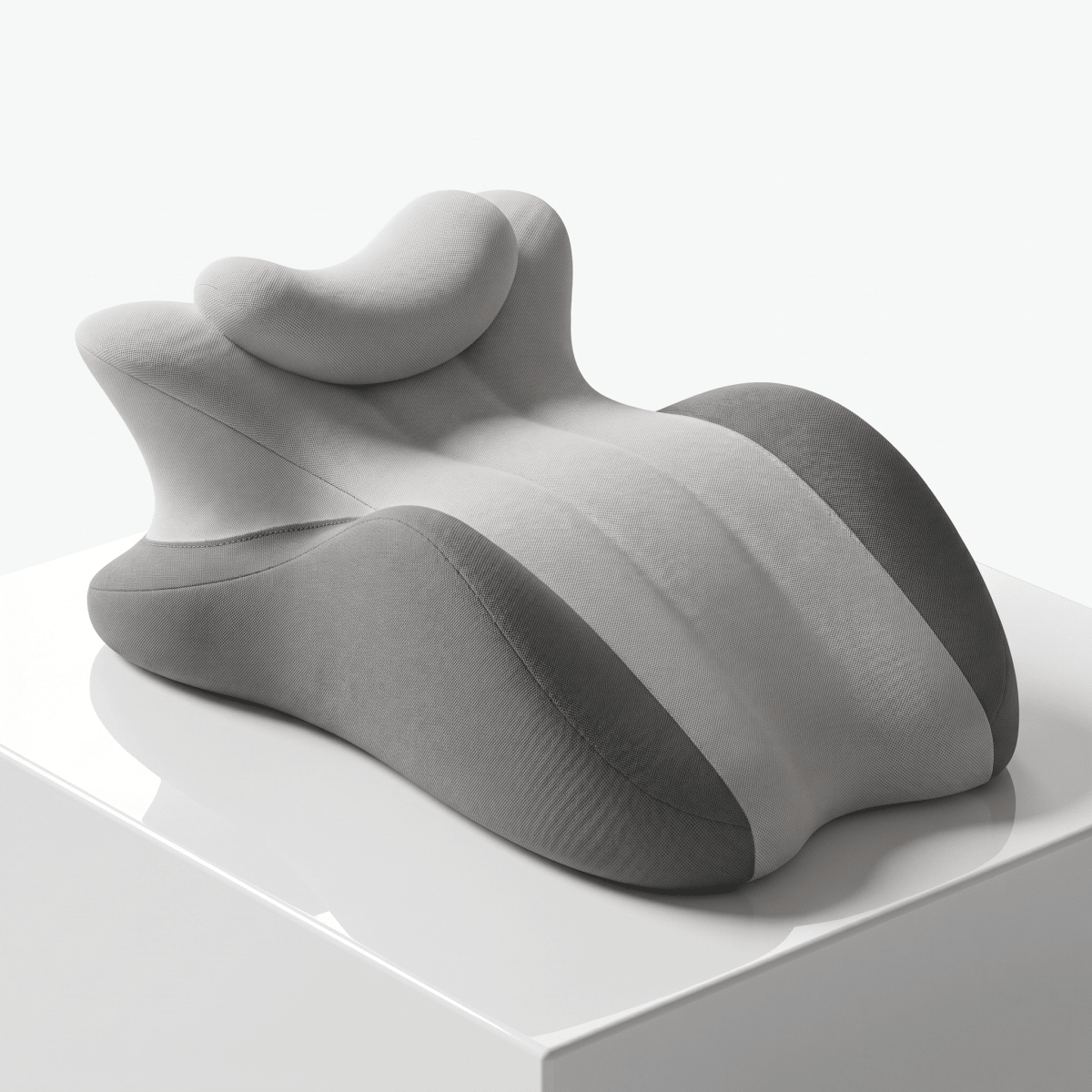
That exact checklist is what led to the design of the Hausenlicht Orthopedic Lounge Wedge.

Five Zones. One Structure. Every Variable Covered.
The Hausenlicht Orthopedic Lounge Wedge isn't a pillow. It's a single-piece, high-density memory foam structure built around five anatomically mapped zones — each one answering a point on the checklist above:
Zone A — Cervical Support Cradle: A contoured cradle that supports the natural curve of the neck, distributing the load of your skull evenly and eliminating tech neck at the source.
Zone B — Chest Support Zone: A gently curved depression that keeps the chest open, preventing the rounded-shoulder position that drives your head forward.
Zone C — Arm Relief Channels: Integrated side tunnels that let your arms rest naturally while holding a phone — eliminating hand numbness and elbow pressure.
Zone D — Side Stabilization Wings: Lateral supports that keep your body from twisting or rolling onto your side or stomach.
Zone E — Lumbar Support Arch: A contoured lower section that holds the natural inward curve of your lower back, preventing the slump caused by flat headboards.
Every other product addresses one variable. The Hausenlicht maps to the entire postural chain at once — cervical, thoracic, lumbar, and arms — in one integrated structure that keeps you supported the whole time you're lounging.
That's not a pillow. It's an ergonomic intervention.
SEE THE 5-ZONE DESIGN & CHECK PRICING → 40% off while inventory lasts
"I Didn't Realize How Much Pain I'd Been Living With"
The most common thing people report isn't dramatic. It's that they stop noticing the pain they'd quietly accepted as normal — the stiff mornings, the tension headaches, the dead-arm wake-ups.


The Choice You're Making Every Night
Every night you spend hunched over your phone on flat, collapsing pillows is another night of compressive force on cervical discs that don't regenerate. Another stiff morning you'll blame on your mattress. Another headache you'll blame on stress. Another restless night you'll blame on a busy mind.
The damage is cumulative. It doesn't announce itself until it's already significant. People don't end up with disc degeneration overnight — they get there one scrolling session at a time.
You're not going to stop using your phone in bed. Nobody is. The only real question is whether you keep doing it on a surface that's quietly working against your spine — or one engineered to protect it.
Hausenlicht backs the Lounge Wedge with a 60-day, money-back guarantee. Use it every night for two months. If your mornings aren't easier, send it back for a full refund — no risk on your end.
TRY IT RISK-FREE FOR 60 DAYS → Full refund if it doesn't work · 40% off today

 CHECK AVAILABILITY →